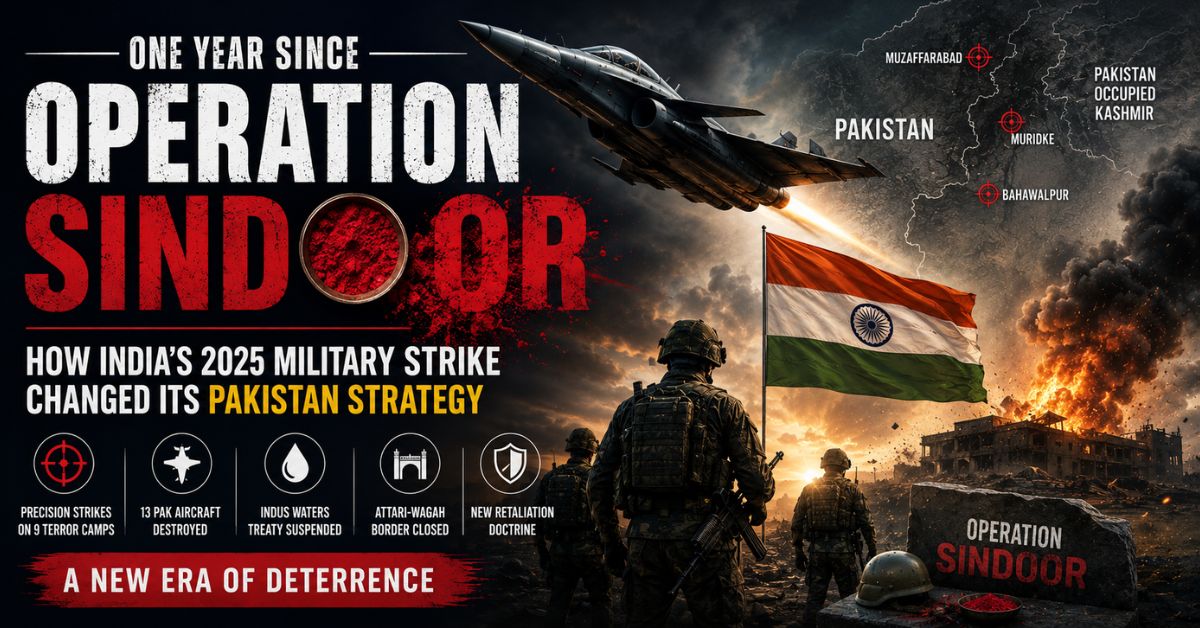
Operation Sindoor Anniversary Highlights
- Operation Sindoor was launched by India on May 7–8, 2025, after the deadly Pahalgam terror attack that killed 26 tourists in Jammu and Kashmir.
- The Indian Armed Forces carried out coordinated precision strikes on terror infrastructure across Pakistan and Pakistan-occupied Jammu and Kashmir.
- Indian military officials say the operation introduced a new retaliation-based deterrence doctrine and challenged Pakistan’s “nuclear bluff.”
- The campaign combined military force with diplomatic, economic, and information warfare measures including suspension of the Indus Waters Treaty framework and closure of the Attari-Wagah border.
- One year later, Operation Sindoor continues to shape India’s defence policy, military modernization, and national security strategy.
One year after India launched Operation Sindoor, the military campaign remains one of the most discussed national security developments in South Asia. The operation, carried out in May 2025 after the deadly Pahalgam terror attack, is now being viewed as a turning point in India’s military doctrine, cross-border response strategy, and defence modernization efforts.
On May 8, 2026, the first anniversary of Operation Sindoor was marked across India with military tributes, government statements, and fresh operational disclosures from senior armed forces officials. Prime Minister Narendra Modi, President Droupadi Murmu, Defence Minister Rajnath Singh, and military commanders described the mission as a defining moment in India’s fight against terrorism.
What Was Operation Sindoor?
Operation Sindoor was a coordinated tri-service military campaign launched by India during the night of May 7 and May 8, 2025. The operation targeted terrorist infrastructure located inside Pakistan and Pakistan-occupied Jammu and Kashmir after the April 2025 terror attack in Pahalgam that killed 26 tourists.
According to military officials and anniversary briefings released in May 2026, the operation involved the Indian Army, Indian Air Force, and Indian Navy working together in a synchronized strike mission against multiple terror-linked facilities.
Indian authorities described the operation as a calibrated response against cross-border terrorism rather than a declaration of war. The government repeatedly maintained that the targets were terror facilities connected to groups including Lashkar-e-Taiba and Jaish-e-Mohammed.
The Pahalgam Terror Attack That Triggered the Operation
The immediate trigger for Operation Sindoor was the Pahalgam terror attack on April 22, 2025.
Armed terrorists linked to The Resistance Front, widely described as an offshoot of Lashkar-e-Taiba, attacked tourists in Jammu and Kashmir’s Pahalgam region. According to reports released afterward, 26 civilians were killed. Indian agencies alleged that the attackers deliberately separated victims on religious lines before opening fire, which intensified national outrage and security concerns.
The incident quickly became one of the most politically and emotionally significant terror attacks in recent Indian history. Government officials stated that the nature of the killings represented an attempt to create communal division and destabilize internal security.
Within days of the attack, high-level meetings were held between political leadership, intelligence agencies, and the armed forces to formulate a response strategy.
How Operation Sindoor Was Carried Out
Military briefings released over the past year suggest that Operation Sindoor was executed in several stages involving air power, missile strikes, drone warfare, artillery systems, and naval positioning.
Precision Strikes on Terror Camps
India reportedly struck nine major terror infrastructure locations spread across Pakistan and Pakistan-occupied Jammu and Kashmir. These included facilities linked to Lashkar-e-Taiba and Jaish-e-Mohammed.
According to anniversary statements from military officials, seven targets were neutralized by the Indian Army using long-range artillery systems and drones, while the Indian Air Force struck the remaining locations through precision aerial attacks.
Satellite imagery and target lists released before the first anniversary also showed the locations India claimed were destroyed during the mission.
Air Force Operations and Aircraft Losses
One of the most discussed aspects of Operation Sindoor has been the aerial engagement that followed the initial strikes.
On the anniversary of the operation, Air Marshal Awadhesh Kumar Bharti stated that Indian forces struck 11 Pakistani airfields and destroyed 13 Pakistani aircraft during the broader conflict phase that followed the first attacks. He also claimed that India neutralized a high-value airborne asset at a distance exceeding 300 kilometers.
The Indian Air Force later released commemorative footage showing missile launches, aircraft activity, and strike visuals connected to the mission.
Naval Deployment in the Arabian Sea
The Indian Navy also played a major role during the operation.
A Carrier Battle Group was positioned in the Arabian Sea to establish maritime dominance and prevent any escalation from the sea front. Defence analysts later described the deployment as an important deterrence measure because it expanded pressure beyond the land border.
The naval positioning also demonstrated India’s intention to present the operation as a full-spectrum strategic response rather than a limited border skirmish.
The Six Key Pillars of Operation Sindoor
By May 2026, military leadership had formally outlined six major lessons and doctrinal shifts emerging from Operation Sindoor.
These principles are now being widely discussed in defence and strategic circles.
1. Challenging the “Nuclear Bluff”
Indian military leadership stated that the operation demonstrated there was still operational space for conventional warfare below the nuclear threshold.
The strikes deep inside Pakistani territory were presented as proof that nuclear threats would not automatically prevent conventional retaliation against terror attacks.
This has become one of the most important strategic narratives associated with Operation Sindoor.
2. Full Tri-Service Integration
The operation highlighted coordination between the Army, Navy, and Air Force at an unprecedented scale.
Officials repeatedly emphasized that the campaign was not led by a single service branch but was planned as an integrated military mission with synchronized timing and intelligence sharing.
3. Rise of Indigenous Defence Technology
Operation Sindoor became closely tied to India’s “Make in India” defence strategy.
Military officials credited several indigenous systems for operational success, including BrahMos cruise missiles, Akash air defence systems, and Indian-developed drones.
The anniversary events also focused heavily on India’s growing domestic defence manufacturing ecosystem and export ambitions.
4. Precision With Controlled Escalation
India maintained that the initial strikes specifically targeted terror infrastructure and avoided civilian areas or regular Pakistani military installations during the first phase.
Officials described this approach as “non-escalatory intent,” arguing that India sought to maintain international legitimacy while still delivering a forceful response.
This distinction became central to India’s diplomatic messaging after the operation.
5. Multi-Dimensional Warfare
Operation Sindoor was not limited to military action.
India also suspended the Indus Waters Treaty framework, shut the Attari-Wagah border crossing, restricted bilateral trade, and revoked visas for Pakistani nationals.
The phrase “blood and water cannot flow together” became closely associated with the government’s broader response strategy.
Diplomatic pressure, economic measures, intelligence coordination, and information warfare were all presented as parts of the same campaign.
6. A New Retaliation Doctrine
Perhaps the most important long-term outcome was the shift in India’s declared response framework.
Military officials stated that future large-scale terror attacks would now be treated as acts of war rather than isolated terror incidents. This represented a major change from earlier doctrines that often focused on restraint and diplomatic engagement.
The message was clear that India intended to institutionalize retaliation-based deterrence.
How Operation Sindoor Changed India’s Defence Planning
Over the past year, Operation Sindoor has influenced defence procurement, military modernization, and strategic planning.
Reports released during the anniversary period suggest that India accelerated investments in drones, electronic warfare systems, missile defence, surveillance infrastructure, and rapid deployment units after lessons learned during the operation.
The military has also reportedly formed specialized units such as Rudra Brigades and Bhairav commando groups designed for faster tactical response and integrated battlefield operations.
Officials described the operation as a major push toward technology-driven warfare rather than traditional manpower-heavy strategies.
International and Political Impact
Operation Sindoor also reshaped India’s diplomatic posture.
Indian officials used the anniversary to reinforce the country’s zero-tolerance approach toward cross-border terrorism. Statements from the Prime Minister, External Affairs Minister S. Jaishankar, and Home Minister Amit Shah all emphasized that India would continue to respond decisively to future attacks.
The operation also increased international attention on South Asian security dynamics and nuclear deterrence debates.
Within India, the mission became a major political and symbolic event, frequently referenced in speeches, military ceremonies, and public campaigns.
Operation Sindoor Book and Movie
The operation has already entered popular culture.
Retired Lieutenant General K.J.S. “Tiny” Dhillon authored the book Operation Sindoor: The Untold Story of India’s Deep Strikes Inside Pakistan, which is widely considered one of the main narrative accounts of the campaign.
In March 2026, filmmaker Vivek Agnihotri and producer Bhushan Kumar announced a feature film adaptation based on the book and the broader events surrounding the operation.
The filmmakers stated that the project would focus on the strategic planning, military execution, and geopolitical tensions linked to the operation.
Why Operation Sindoor Still Matters in 2026
One year later, Operation Sindoor continues to shape India’s national security discussions.
For supporters, the operation represents a decisive shift from reactive security policy to proactive deterrence. For defence analysts, it marks one of the most significant demonstrations of integrated Indian military capability in recent years.
The operation also accelerated debates around indigenous weapons, rapid warfare technologies, nuclear deterrence, and hybrid conflict strategies.
Most importantly, Operation Sindoor changed the language of India’s counter-terror doctrine. The campaign established a framework in which military, diplomatic, economic, and information tools could all be used together as part of a unified national response.
As India marks the first anniversary of the operation in May 2026, the message from military and political leadership remains consistent. The country now views Operation Sindoor not as an isolated mission, but as the beginning of a long-term strategic doctrine that will shape future responses to terrorism and regional security threats.